By Santiago Villaseñor | News & Local Affairs
Two earthquakes made September 19 part of Mexico City’s collective memory. This year’s national drill showed how that memory has become something more practical: a citywide habit of preparation.
At noon on Saturday, Mexico City stopped.
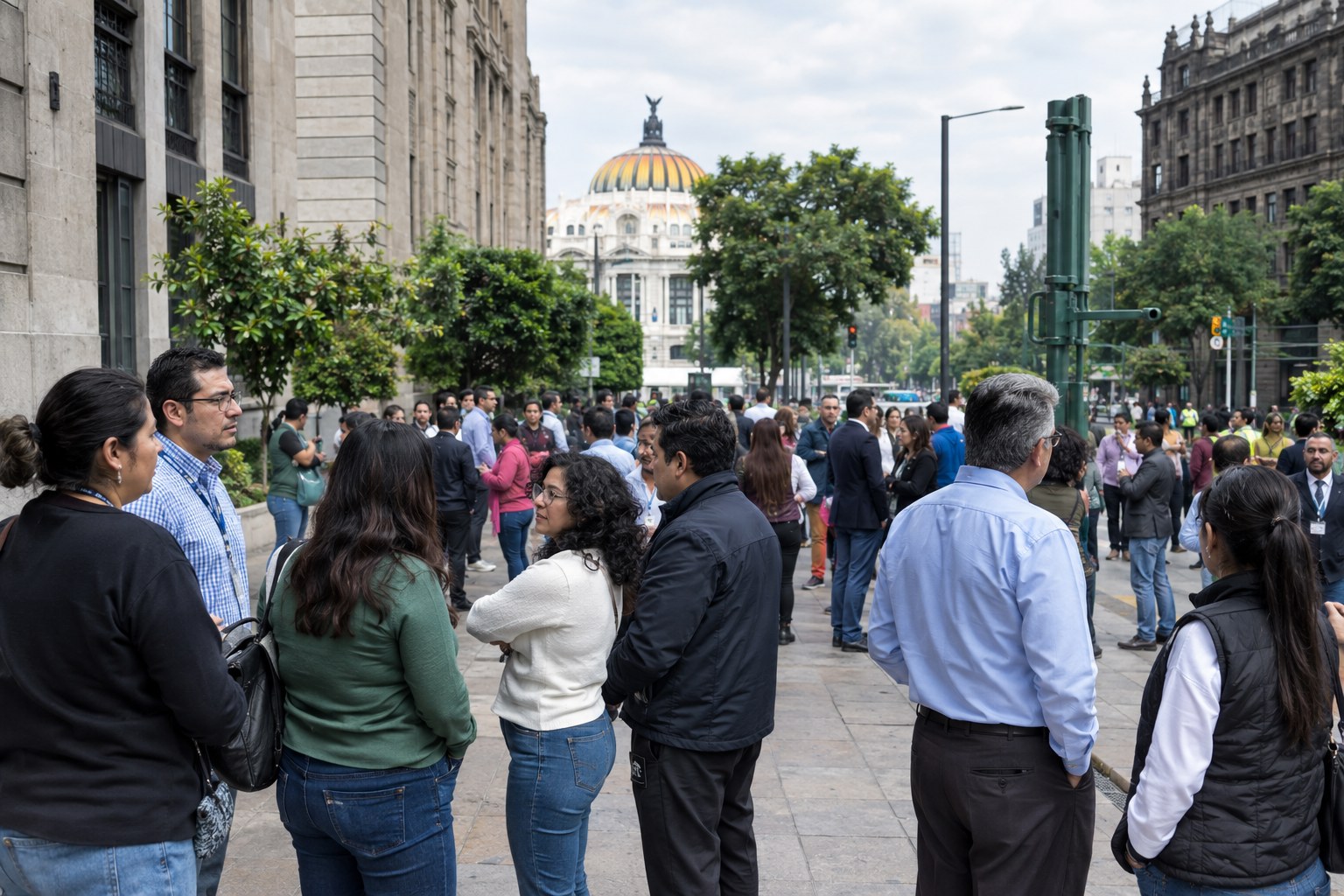
The familiar seismic-alert tone moved through streets, apartment buildings and public spaces. Phones sounded. Families left their homes. Workers, shoppers and restaurant staff stepped toward designated safety areas. Across the capital, millions of people rehearsed something nobody wants to experience for real.
It was a drill. Everyone knew that.
But in Mexico City, an earthquake drill on September 19 is never only a drill.
A Date the City Does Not Treat Casually
September 19 carries an unusual weight here because two of the most consequential earthquakes in the city’s modern history struck on the same calendar date, 32 years apart.
On September 19, 1985, a magnitude 8.1 earthquake off the Pacific coast devastated parts of the capital. The disaster transformed Mexico City physically, politically and socially. It also exposed how unprepared the city was for a catastrophe of that scale.
Then, on September 19, 2017, a magnitude 7.1 earthquake struck central Mexico. Its epicenter was much closer to the capital, and buildings again collapsed across the city. The coincidence of the date made an already traumatic event feel almost impossible to process.
For many residents, “19S” needs no explanation.
It is shorthand for memory: where you were, who you called, which building you watched, the hand signals of rescuers asking crowds for silence, and the spontaneous networks of volunteers who carried water, medicine, tools and food through neighborhoods.
Researchers at UNAM have described how the memories of 1985 and 2017 became intertwined in public life, with the later earthquake immediately reviving comparisons to the earlier disaster. That overlap of memory is part of why drills on this date feel different from routine safety exercises.
What Happened in the 2026 Drill
The Second National Earthquake Drill of 2026 began at 12:00 p.m. on September 19.
The principal scenario imagined a magnitude 7.7 earthquake near Tehuacán, Puebla — a scenario selected because a quake in that region could be strongly felt in Mexico City and provide relatively little warning time.
Other parts of the country practiced different seismic scenarios appropriate to their regional risks. According to Mexico’s federal civil-protection authorities, an estimated 33 million people participated nationwide.
The exercise also tested the national cellphone emergency-alert system. Federal officials reported that the alert signal was transmitted through 96.5% of cellphone antennas nationwide. See the federal post-drill report.
In Mexico City, authorities reported participation by roughly 7.9 million people. Local reporting citing the C5 said 98.93% of the capital’s loudspeakers activated successfully during the exercise.
Those numbers matter, but they are not really the most interesting part of the story.
The real question is what happens between drills.
Preparedness in Mexico City Has Become Everyday Culture
After 1985, earthquake preparedness in the capital changed dramatically.
Mexico expanded civil-protection institutions, seismic monitoring and early-warning systems. The first sensors of what became the Mexican Seismic Alert System began operating in the early 1990s. Today, earthquake alerts are part of the city’s soundscape in a way that can be difficult for newcomers to understand until they live here.
The alarm is not background noise.
Residents learn which stairwell to use. Apartment buildings mark meeting points. Offices organize brigades. Parents learn school protocols. People talk about whether they should evacuate from a particular floor or remain in a lower-risk area. Many households keep flashlights, portable batteries, water, copies of documents and basic emergency supplies where they can be reached quickly.
That does not mean everyone is perfectly prepared. Far from it.
It means preparedness has entered normal conversation.
That is one of the lasting changes produced by the earthquakes themselves.
The Weekend Test Was Important
This year’s September drill was unusual because it was held on a Saturday.
That matters.
Most people know the evacuation route at work because an employer or building manager has told them where to go. Home is different. Families may not have assigned responsibilities. Neighbors may not know one another. Visitors may have no idea where a building’s safe zones are.
A weekend drill forces a different question:
If the alert sounded at home right now, would everyone in your household know what to do?
That is a much more useful question than simply knowing where the office staircase is.
Federal authorities encouraged households to use the Saturday exercise to review family emergency plans and evacuation routes. The drill also offered a reminder to check the small things that often get overlooked: whether a flashlight still works, whether emergency contacts are current and whether everyone knows where the gas or electricity can be shut off if necessary.
No, September Is Not “Earthquake Month”
The date has produced an understandable urban mythology.
After major earthquakes occurred on September 19 in 1985, 2017 and again in 2022, the idea that September is somehow Mexico’s earthquake month became difficult to avoid.
Scientists do not support that conclusion.
UNAM researchers have repeatedly explained that earthquakes cannot be predicted by calendar date and that the historical record does not show September to be uniquely capable of producing major earthquakes. Mexico is highly seismic because of its geology, not because of the month printed at the top of the calendar.
UNAM’s explanation of the September 19 coincidence is worth reading, particularly for anyone new to the city.
The emotional association, however, is real.
And that distinction matters: the science does not say September is cursed; collective memory says September is difficult.
What Residents Should Check Now — Not During the Next Alert
- Know your building’s plan. Identify the safest route and the designated meeting point before an emergency.
- Understand whether evacuation is appropriate. Procedures can differ depending on the building, floor and timing of the alert.
- Keep basic emergency supplies accessible. A flashlight, charged power bank, water, medication and important contact information are more useful where you can reach them quickly.
- Know how you will reconnect. Families should decide where to meet and who to contact if cellular networks become overloaded.
- Report alert-system failures. If a nearby public loudspeaker does not activate during an official test, residents can report the problem through the city’s official channels so it can be inspected.
If You Are Visiting Mexico City
Do not panic if you hear the seismic alert. Follow instructions from hotel, restaurant, museum or building staff and move calmly. Do not use elevators during an evacuation. If you are staying in an apartment rental, ask the host or building staff about the emergency route when you arrive — not after an alert begins.
Visitors are sometimes surprised by how seriously residents react to the alarm. That reaction is not theatrical. It is learned behavior in a city whose recent history has shown why seconds matter.
If you are new to the capital, our First Time in Mexico City guide covers the basics of arriving and settling in, while our complete Mexico City transportation guide explains how to move around the city.
A City Remembers by Practicing
There is a tendency to describe Mexico City’s response to earthquakes only through the language of resilience.
That word can become too easy.
What is more interesting is the infrastructure of memory the city has built: the alarms, drills, evacuation maps, brigades, sensors, emergency backpacks, family plans and conversations between neighbors.
None of those can eliminate seismic risk.
They can make the city better prepared for it.
September 19 remains a day of mourning for people who lost family, friends, homes and workplaces in 1985 and 2017. It is also now a recurring civic exercise — a date on which remembrance is translated into action.
At noon this year, millions of people walked out of buildings knowing there was no earthquake beneath their feet.
They walked out anyway.
That may be the clearest expression of what September 19 has become in Mexico City: not a superstition, not simply an anniversary, but a habit of refusing to be caught completely unprepared.
Quick Answers
Why is September 19 important in Mexico City?
Major earthquakes struck Mexico City on September 19 in both 1985 and 2017. The date has become closely associated with earthquake remembrance and preparedness.
Was there an earthquake in Mexico City on September 19, 2026?
The major citywide event on September 19, 2026 was the Second National Earthquake Drill. Authorities used a hypothetical magnitude 7.7 earthquake near Tehuacán, Puebla, to test emergency response.
Can scientists predict an earthquake on September 19?
No. Seismologists cannot predict an earthquake by a specific date. UNAM researchers have explained that the repetition of major earthquakes on September 19 does not make that date scientifically predictive.
Sources: Coordinación Nacional de Protección Civil; Secretaría de Seguridad y Protección Ciudadana; Ciencia UNAM; Revista Mexicana de Sociología, UNAM.