
A practical, visitor-friendly guide to the Metro, Metrobús, the MI Card, ECOBICI, Cablebús, trolleybuses, airports, taxis, ride apps, walking, bikes and the fastest way to understand the city’s enormous transportation network.
If you understand one thing first, make it the Tarjeta de Movilidad Integrada (MI). It is the city’s reloadable transit card and the simplest way to move across most of Mexico City’s public transportation network.
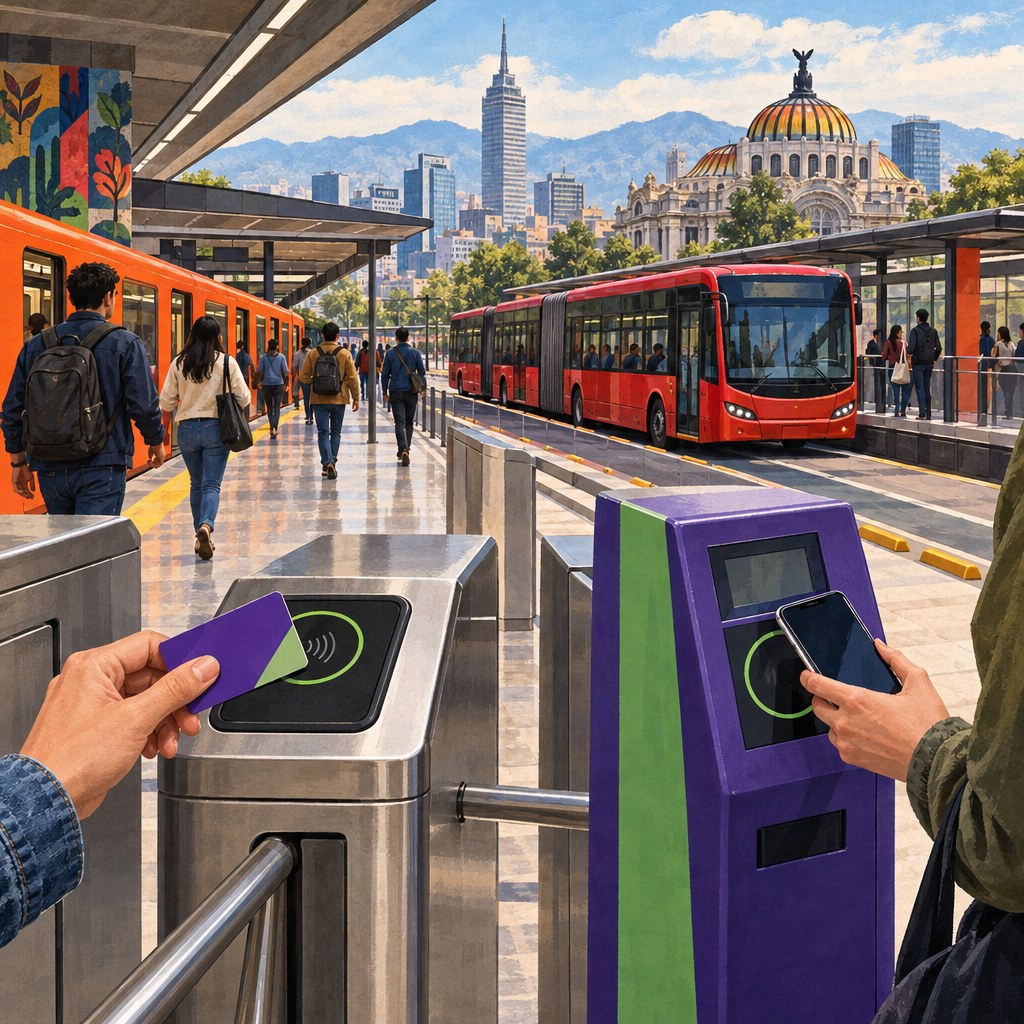
You can buy or recharge a physical MI card at Metro ticket offices and machines, as well as machines in Metrobús, Cablebús and Tren Ligero stations. The easiest visitor strategy is to buy one early in your trip and keep enough balance on it so you are not searching for a machine during rush hour. The card works across Metro, Metrobús, Cablebús, Trolebús, Tren Ligero, RTP and other integrated services. ECOBICI can also be linked to your account.
You can recharge a physical card from a compatible NFC phone through the official App CDMX, and the city also maintains a large external recharge network. A virtual MI card is available in App CDMX on supported Android and Huawei phones. For visitors, the physical card remains the most universally straightforward option.
Mexico City’s Metro has 12 lines and nearly 200 stations. It is usually the most efficient option when traffic above ground is heavy. Directions are shown by the name of the terminal station at the end of the line, so before you board, know the final station in the direction you are traveling. Transfers within the Metro network generally do not require paying another fare once you are inside the system.
Typical operating hours: Monday–Friday 5:00 a.m.–midnight; Saturday 6:00 a.m.–midnight; Sunday and holidays 7:00 a.m.–midnight. Weekday rush hours can be extremely crowded, especially roughly 7:30–9:30 a.m. and again during the evening commute. If you have luggage or can travel off-peak, do it.
Paper magnetic tickets are no longer the standard entry method: the Metro completed its transition to MI-card access in 2024. Contactless bank-card payment has also been introduced at many turnstiles, but carrying an MI card is still the simplest way to connect across the entire network.
Metrobús is the city’s bus rapid transit system. The buses run in dedicated lanes, making them far more predictable than ordinary street traffic. There are seven lines. For visitors, particularly useful corridors include Line 1 along Insurgentes, Line 7 along Paseo de la Reforma, and Line 4 for airport and Historic Center connections.
The standard fare is $6 MXN. The special Metrobús airport service between the city and AICM terminals costs $30 MXN. Transfers among Metrobús lines are free when made within the system’s allowed transfer window and in the same general direction of travel. Typical hours are around 4:30 a.m.–midnight Monday through Saturday and 5:00 a.m.–midnight Sundays and holidays, though individual routes can vary.
| Service | Typical fare | Best use |
|---|---|---|
| Metro | $5 MXN | Fast cross-city trips |
| Metrobús | $6 MXN | Major avenues |
| Cablebús | $7 MXN | Hillside districts + scenic connections |
| Trolebús | $4 MXN traditional / $7 MXN special infrastructure | Electric surface corridors |
| Tren Ligero | $3 MXN | Tasqueña → Xochimilco corridor |
| RTP | $2 MXN ordinary / $4 MXN express / $7 MXN Nochebús | Areas beyond rail/BRT routes |
Fares shown here were verified in September 2026. Special routes, airport services and newly opened lines may have different pricing.
The best transportation in Mexico City changes with the distance, neighborhood, hour and weather. You do not need to master every system. You need to know which one solves the trip you are making.
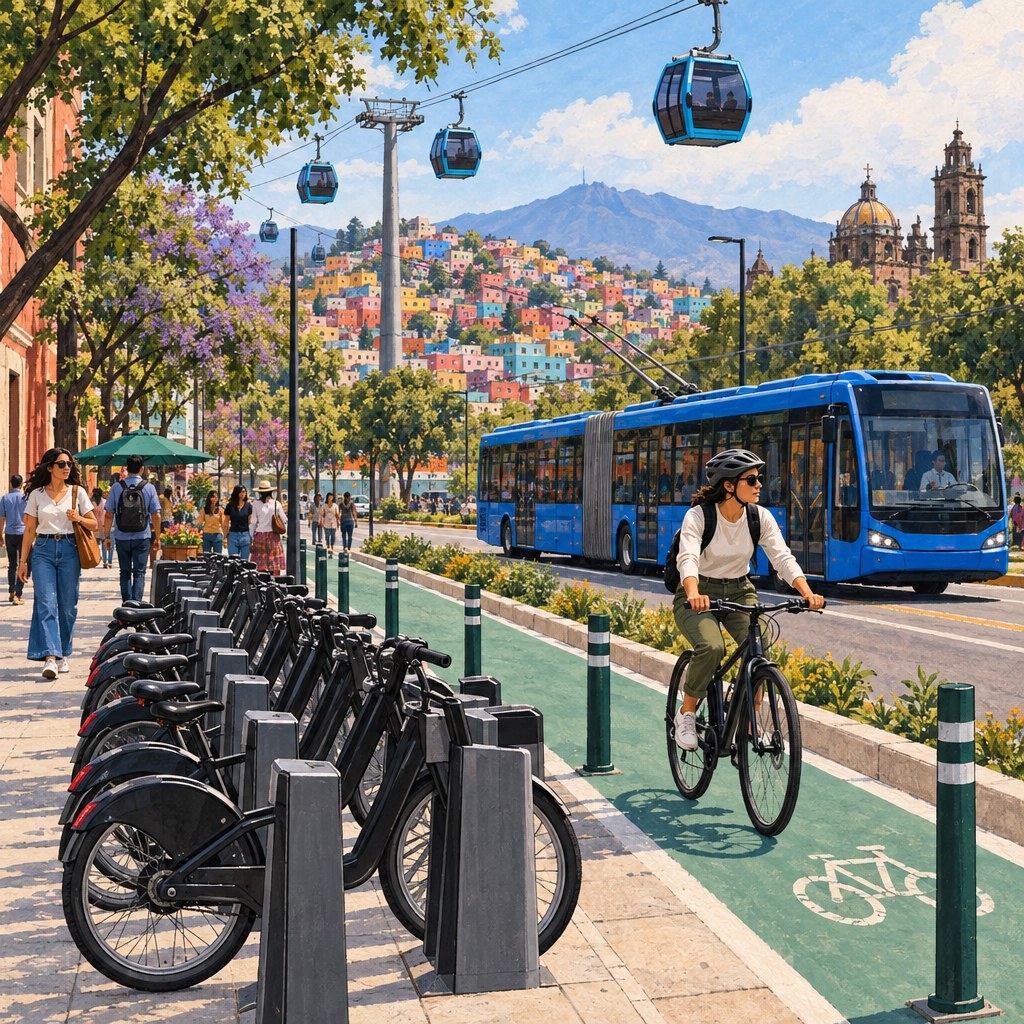
The public bike-share system is excellent for Roma, Condesa, Juárez, Polanco, Reforma and many central areas. Find bikes and docks in the ECOBICI app, scan a QR code to unlock, then dock the bicycle firmly and wait for confirmation that the return was successful.
Important: standard rides are time-limited, and fees apply after the included ride window. Current plan pricing differs by residency, so international visitors should select the foreign-user option shown by ECOBICI rather than buying a resident-only rate.
Mexico City’s cable-car transit is both practical and visually extraordinary. The fare is generally $7 MXN. Lines connect elevated neighborhoods to Metro and other transit hubs; Line 3 through the Chapultepec area is particularly interesting to visitors. Typical hours are 5:00 a.m.–11:00 p.m. weekdays, 6:00 a.m.–11:00 p.m. Saturdays and 7:00 a.m.–11:00 p.m. Sundays/holidays.
These blue electric buses are a useful surface option. Traditional lines are generally $4 MXN; special infrastructure routes such as elevated services are $7 MXN. The Eje Central corridor is useful for central-city travel, and its Nochebús service provides an overnight option at a special fare.
The light rail from Tasqueña to Xochimilco is one of the most useful visitor routes in the south of the city. Connect from Metro Line 2 at Tasqueña and continue toward Xochimilco. The typical fare is $3 MXN using the MI card.
RTP fills gaps where rail and BRT do not reach. Ordinary service is very inexpensive, with express and overnight options costing more. For a first-time visitor, it is usually easiest to use RTP when a route planner specifically recommends it rather than trying to memorize the network.
Uber, DiDi and similar ride apps are useful for luggage, late nights, rain and door-to-door trips. Official street taxis in Mexico City are white and pink. The Mi Taxi feature inside App CDMX can help verify an official taxi, share a trip and access emergency tools.
This is where old travel guides can now be wrong. Lime, JET and Whoosh returned during a 2026 pilot, but the shared-scooter program ended on August 31, 2026. As of September 2026, those rental fleets are not authorized to keep operating while SEMOVI evaluates the pilot and possible future rules. Do not plan a trip assuming a shared scooter will be waiting on the corner.
Mexico City is enormous, but many individual districts are highly walkable. Centro Histórico, Roma Norte, Condesa, Juárez and parts of Polanco reward walking because the interesting places are often only a few blocks apart. Use transit to reach the neighborhood, then walk locally. Watch uneven pavement, driveway entrances, bike lanes and long crossings on major avenues.
This is the practical part: arriving with luggage, getting home late, knowing what to download, and avoiding the small mistakes that make a huge city feel harder than it really is.

Metrobús Line 4 provides service from both Terminal 1 and Terminal 2 and is often the cleanest public-transport option for visitors heading toward central Mexico City. The airport fare is $30 MXN. Machines for buying/recharging the MI card are available at the airport Metrobús access points.
If you prefer a car, use one of the authorized airport taxi booths inside the terminal. AICM continues to regulate the federal airport zone, and app-based pickups can be restricted or require a meeting point outside the authorized taxi area. If using a ride app, follow the latest in-app pickup instructions rather than accepting an unsolicited ride from someone in the arrivals hall.
The new Tren Felipe Ángeles now links AIFA with Buenavista in central Mexico City. The airport publishes an introductory fare of $45 MXN for trips to or from AIFA, payable with the MI card. Initial end-to-end journey time is approximately one hour, with connections at Buenavista to Metro, Metrobús, ECOBICI and other city transportation.
Keep your phone and wallet out of easy-access exterior pockets in crowded vehicles. Wear backpacks in front during rush hour. Let passengers exit before boarding. At night, if a route feels confusing, a verified ride app or authorized taxi can be worth the extra cost.
The Metro has clearly marked cars and platform areas reserved for women and children under 12 throughout service hours. Metrobús also has designated exclusive areas. Follow the signs and staff instructions at each station.
Accessibility varies by station and line. The Metro maintains elevators, stair lifts and reserved seating at many stations, and guide dogs are permitted throughout the system. Before a trip that requires step-free access, check the specific station rather than assuming every interchange is fully accessible.
Summer downpours can slow road traffic and occasionally affect transit operations. Add extra travel time, especially for an airport trip or timed reservation, and check the live service status before leaving.
App CDMX is the most useful official app because it combines transportation status, routes and MI-card functions. Add the ECOBICI app if you plan to bike. Keep your usual map/navigation app for turn-by-turn routing and your preferred ride app for late-night or luggage-heavy trips.
Check the live route before every important trip. Mexico City transportation is extensive and inexpensive, but temporary maintenance, weather, demonstrations, major events and construction can change the best route. A five-minute check before leaving is better than relying on an old screenshot.