Metrobús, RTP, Trolebús, airport buses, the MI Card — and how to know exactly what you’re looking at before you get on.
Built for the person standing on a Mexico City sidewalk thinking: “Which bus is this, where does it stop, how do I pay, and am I even going the right way?”
This is the part that confuses many first-time visitors: “the bus” is not one single bus system in Mexico City. Different networks use different vehicles, stops, stations, payment patterns and route logic.
You do not need to memorize everything. Start by identifying the vehicle or station in front of you. Once you know which system you’re using, the rest becomes much easier.
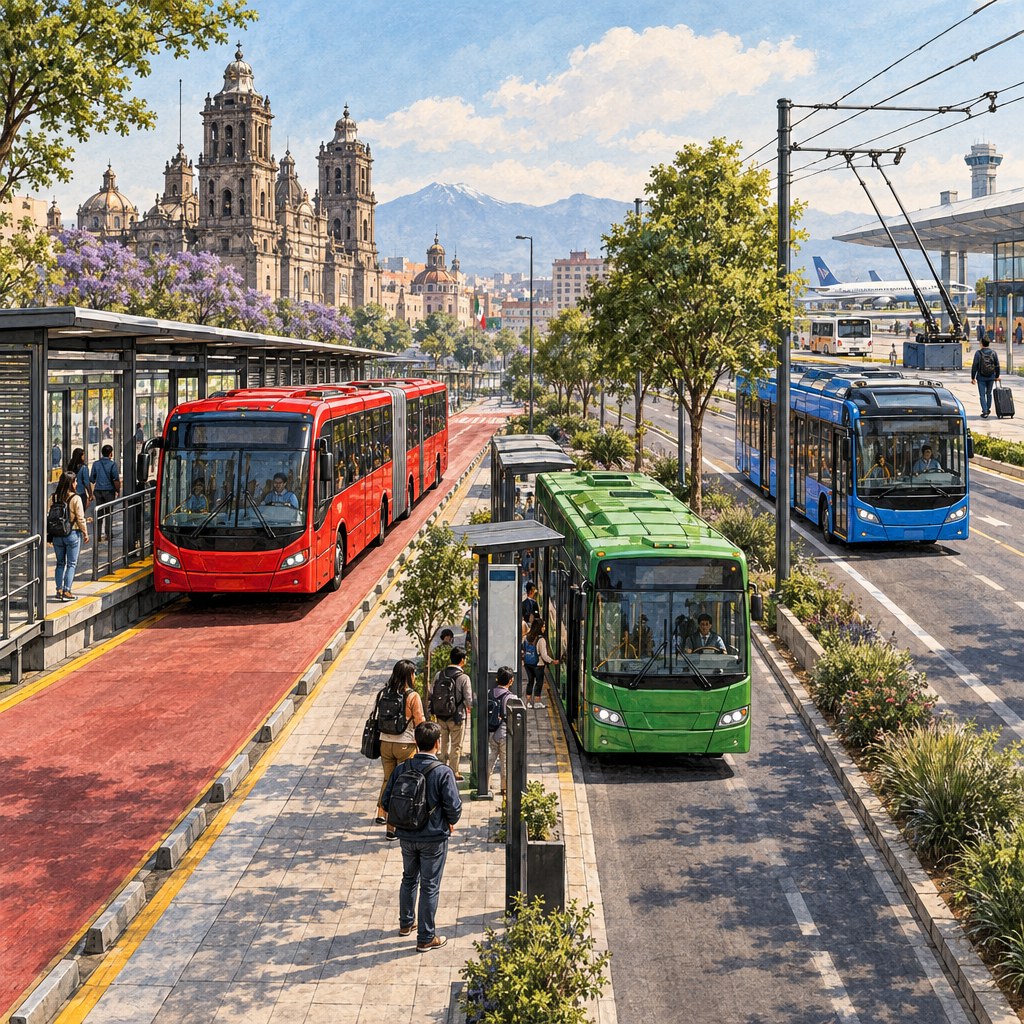
Usually red · station-based
Metrobús
Think of Metrobús as a surface subway that happens to use buses. It runs in dedicated lanes on major avenues and uses recognizable stations or platforms rather than ordinary curbside bus stops.
Best clue: you see a structured station, platform, validators or turnstiles, and large red buses moving in their own lane.
Visitor use: one of the easiest bus systems to learn first. Particularly useful on major corridors such as Insurgentes and Reforma.
RTP is the broader city bus network. It reaches many areas that are not served as directly by Metro or Metrobús and has a much larger collection of routes.
Best clue: a more traditional city bus operating on regular streets, often green, using route endpoints rather than a large enclosed BRT station.
Visitor use: extremely useful once you know your exact route; less intuitive to “just figure out” on the sidewalk.
These are Mexico City’s electric trolleybuses. Many are blue and run on fixed corridors, with some lines using overhead electrical infrastructure and newer sections using specialized rights-of-way.
Best clue: a blue electric bus, often beneath overhead wires, operating along a defined street corridor.
Visitor use: a quiet, useful surface option when your route lines up with one of its corridors.
AICM is connected to central Mexico City by a special Metrobús service. It is part of the Metrobús network but has its own airport fare and airport boarding points.
Where at AICM: Terminal 1, Gate 7; Terminal 2, Gate 2.
Visitor use: a lower-cost airport option if you are traveling light and comfortable using public transit.
If you are completely new to Mexico City buses, learn Metrobús first. Use RTP once you know the exact route you need, and use Trolebús when your destination sits naturally on one of its corridors.
SECTION 2 · YOUR KEY TO THE SYSTEM
The MI Card: How You Pay
The Tarjeta de Movilidad Integrada (MI Card) is the single most useful thing to understand before you start riding buses in Mexico City.
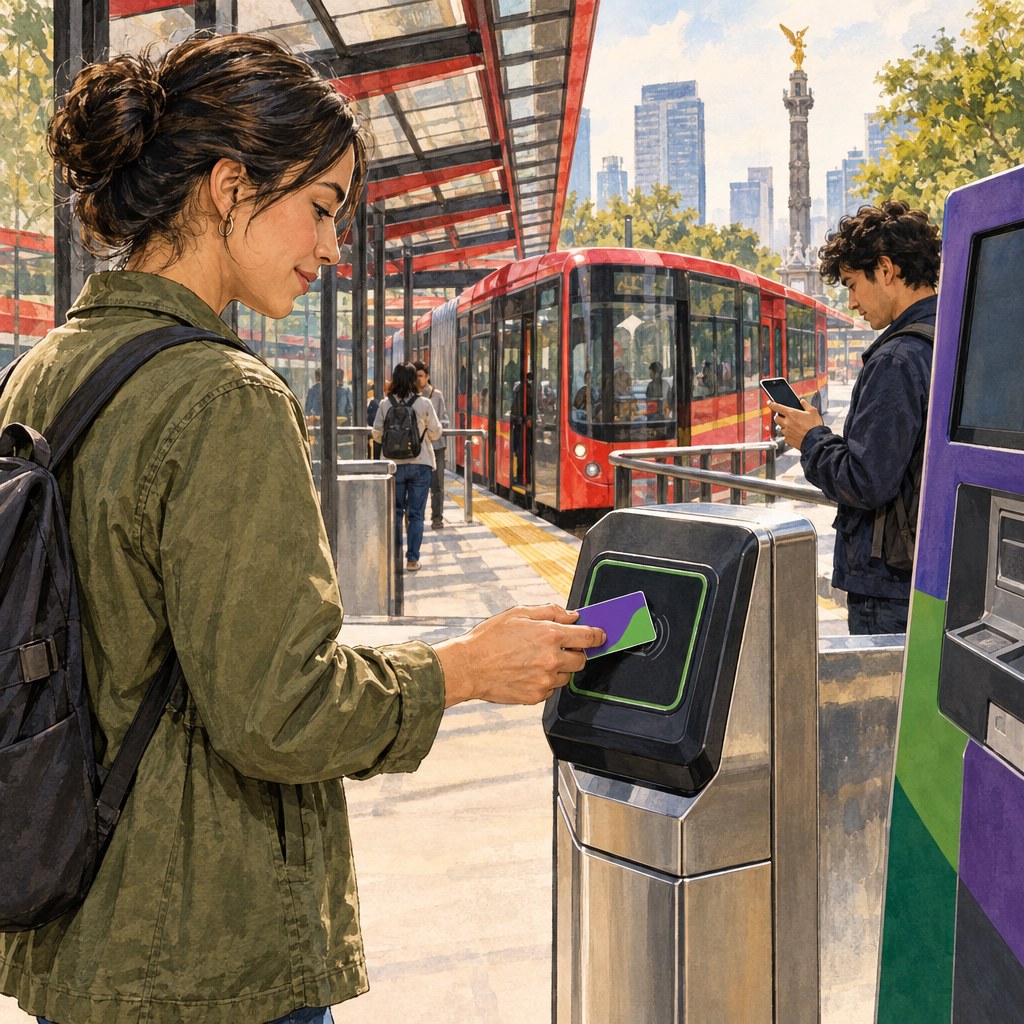
Think of it as your transit key. You load money onto it, then tap it on validators as you enter a station or board a compatible service.
Card cost
$15 MXN
plus the balance you choose to add
Maximum balance
$500 MXN
keep enough for several trips, not your whole wallet
Metrobús
$6 MXN
standard fare; airport service is different
Airport Metrobús
$30 MXN
special AICM service
Important for international visitors: the “$” symbol in Mexico normally means Mexican pesos. Every fare on this page is labeled MXN so you never have to guess whether we mean pesos or U.S. dollars.
Where the MI Card works
The MI system is designed to bring Mexico City transportation under one payment network. You can use it across major integrated services including Metro, Metrobús, Cablebús, Trolebús, Tren Ligero and RTP, with additional integrations throughout the metropolitan mobility network.
Physical card or virtual card?
For a first-time visitor, the physical MI card is still the simplest universal choice. You can buy it at supported station machines and keep it with you throughout your trip.
The updated App CDMX also supports a virtual MI card on compatible Android and Huawei devices, and it can help users recharge physical cards from supported phones. If your phone is compatible and you enjoy using digital wallets, it is worth exploring — but you do not need the virtual version to use the transportation system successfully.
How to Buy and Reload the MI Card Without Getting Flustered
If you were confused the first time you stood in front of a transit machine, you are not alone. The easiest approach is to do this before you are rushing for a bus.
Buy the card once, load enough for several trips, and then treat it like part of your everyday essentials along with your phone and hotel key.
01
Find a machine
Metro and Metrobús stations are usually the easiest places for a visitor to buy or reload an MI card. Look for the vending/recharge machines near the entrance.
02
Choose purchase or recharge
If you do not have a card, choose the purchase option. If you already have one, select the recharge option and follow the machine instructions.
03
Add enough balance
For many visitors, starting around $100–$200 MXN is easier than loading one ride at a time. You can always recharge later.
04
Keep it ready
Do not bury the card at the bottom of your bag. Have it accessible before you reach the gate or validator so you do not stop the flow behind you.
Paying with cash at Metrobús machines
Metrobús states that its machines accept $1, $2, $5 and $10 MXN coins and $20, $50 and $100 MXN bills for cash purchases/recharges. One detail is especially worth knowing before you insert money: the machines do not give change. Have the amount you actually want to load ready.
First-time visitor tip: do not learn the machine while a rush-hour crowd is moving behind you. Buy and load your card during a quieter part of the day, then your first actual bus ride will feel much easier.
Can I reload from my phone?
Yes, on supported devices. The official App CDMX includes tools for mobility and MI-card functions, including physical-card recharge and a virtual MI card on compatible Android/Huawei phones. Digital availability can change by device and payment setup, so if you are visiting from abroad, keep the physical card as your dependable backup.
Before you walk away from the machine
✓ Card in hand Do not leave it in the tray.
✓ Balance loaded Enough for several rides is easier.
✓ Route checked Know the system and direction before boarding.
✓ Official map saved A screenshot can help if your signal drops.
The goal is not to become a transit expert before your first ride.
Your goal is simply to know which bus system you are using, where you are going, and how you are paying. Once those three things are clear, the city immediately feels more manageable.
Current-information note: Transportation routes, fares, payment methods and operating details can change. This guide uses current official CDMX transportation information verified for September 2026 and links readers directly to official sources for the latest route and payment details.